
.png)
From Philosophy to Federal Court: The Redefinition of ‘Woman’ in Australia
How a Philosophy Framework Morphed into Australian Law
I have written before about what a woman is. Not because I am looking for a fight, but because the question is not abstract for me.
Ideas do not stay in seminar rooms. They travel, through journals, advocacy networks, parliamentary submissions, and eventually courtrooms, until they reshape the institutions ordinary people live under. This piece is about one such journey.
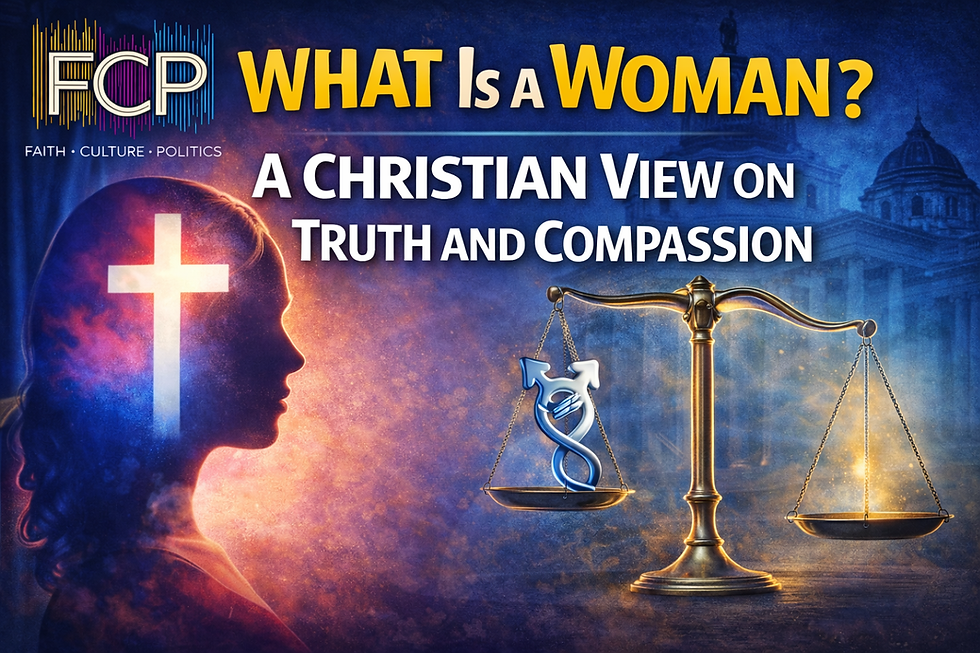
In March of this year, I published What Is a Woman? A Christian Response on Truth, Compassion and Reality, a piece prompted by a moment in Brazilian politics that revealed, in sharp relief, how difficult it has become to speak plainly about biological reality in institutional settings. I argued there that a society losing the ability to ask that question carefully, in good faith and without fear, will not become more compassionate as a result. It will become less able to protect those who depend on it.
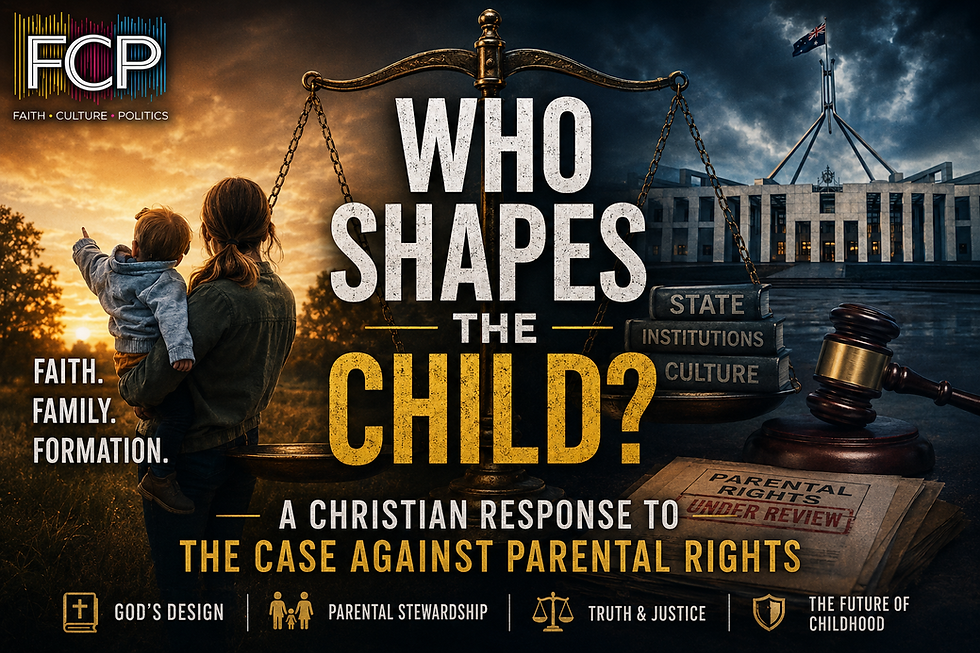
Then, a week ago, I published Who Shapes the Child?, a response to Samantha Godwin’s academic paper Against Parental Rights. That piece traced how a serious, well-constructed legal argument, aligned with institutional incentives, does not remain in journals. It travels. It finds its way into policy, into curriculum, into courtrooms. The question there was about children: who shapes them, and by whose authority.
The question I want to ask in this piece runs alongside both of those, and in some ways upstream of them: not just what a woman is, and not just who shapes children, but how the very definition of ‘woman’ was deliberately reconstructed in academic philosophy, moved through legal scholarship and advocacy, embedded in Australian policy frameworks, and confirmed by a Full Federal Court of three judges in a judgment handed down this month.
I am a husband. I am a father of daughters. I am a grandfather. I have an elderly mother whose life has shaped mine in ways I am still discovering. The women in my life are not ideological categories. They are people I love, and people I am responsible to. When I see increasing legal and institutional uncertainty around what the word ‘woman’ actually means, I cannot treat that as someone else’s concern.
In 2014, a philosophy student named Erica Behr submitted an undergraduate essay titled The Redefinition of Men and Women: A Case for Redefining Gender Terms to Promote Justice for All. It is not a landmark paper. It was not written by a legal scholar or a senior academic. It is the kind of essay produced in philosophy courses across Western universities every year.
That is precisely why it is worth reading carefully.
Not because it is uniquely dangerous, but because it is representative. It shows us, with unusual clarity, the foundational moves that underlie an entire generation of institutional thinking on gender. Ideas, as I said, have destinations. And because the consequences of those moves are now playing out in Australian courts, the moment to examine the argument at its roots is now.
What the Paper Argues - The Redefinition of ‘Woman’ and 'Man'
Behr’s essay is a defence of a philosophical position developed by Talia Mae Bettcher, a philosopher who argues that the words ‘man’ and ‘woman’ should be formally redefined to carry two equally valid meanings: one rooted in biology, and one rooted in self-identification.
Behr’s central claim is that this ‘multiple-meaning model’ is not just philosophically defensible, it is morally required. Justice, she argues, demands it. And crucially, she argues that any feminist who refuses to accept this framework is, whether they realise it or not, lending support to the patriarchal structures that have oppressed women throughout history.
That last move deserves attention, because it is a rhetorical device as much as an argument. By collapsing the distinction between those who reject the multiple-meaning model on principled biological or philosophical grounds, and those who do so out of prejudice, the essay pre-emptively removes space for legitimate dissent. If your only options are acceptance or transphobia, there is no room for a third position, however carefully reasoned, to be heard at all.
Before proceeding, I want to name something plainly. The compassion motivating Behr’s argument is real. Transgender individuals are not abstract ideas, they are people, often navigating deeply personal realities that deserve to be taken seriously.
They are, in the most straightforward Christian sense, our neighbours. They should not be mocked, dismissed, or treated with contempt. Acknowledging the weaknesses in this philosophical argument does not require, and should not produce, anything other than that basic dignity toward the people it seeks to defend.
The Biological Foundation the Essay Skips
Before engaging the philosophical argument on its own terms, it is worth pausing at something the essay asserts but does not defend.
Early in her paper, Behr states that ‘even biological sex is more complicated than the binary system we subscribe to.’ This is offered almost in passing, as a rhetorical clearing of ground before the main argument is built. But it is doing significant load-bearing work. Because if biological sex is genuinely not binary, if the male-female distinction is itself a cultural imposition rather than a natural reality, then the entire structure of her subsequent argument rests on that premise.
The claim does not survive scrutiny.
The reproductive biology of sexually reproducing species is one of the most thoroughly documented areas of natural science. The human species reproduces through the union of two distinct gamete types: the large, non-motile ovum produced by the female reproductive system, and the small, motile sperm produced by the male. At the level of reproductive function, this is a dyad. There is no third gamete type. There is no intermediate reproductive role. Every human being who has ever lived was produced through exactly this process.
The existence of intersex conditions, chromosomal variations, hormonal anomalies, developmental differences, does not dissolve this biological reality. Variation within a system is not evidence that the system does not exist. Intersex conditions, while real and deserving of compassionate care, affect a small fraction of the population and are typically understood clinically as variations within a framework organised around reproductive biology, rather than as evidence that the framework itself is illusory. The existence of people born with one arm does not mean the human body is not designed with two.
The Christian tradition has always understood this not merely as biology but as design. Genesis 1:27 does not say that God created human beings along a spectrum. It says he created them male and female. The biological distinction is not incidental to the image of God in humanity, it is part of how that image is expressed, and how new human life comes into being. When Jesus is asked about marriage in Matthew 19, he returns to this same text: ‘Haven’t you read that at the beginning the Creator made them male and female?’ The binary is not a cultural residue. It is a created reality, and it is treated as such across the entirety of Scripture.
New life begins through the union of male and female. Even where modern medicine assists, it does not replace this reality, it works through it. To acknowledge this is not to exclude or diminish anyone. It is to remain truthful about the nature of human life.
The Argument the Essay Does Make
Setting aside its biological foundation, the philosophical argument Behr builds is worth engaging on its own terms, because it is more sophisticated than it is sometimes given credit for.
She begins by critiquing two existing models within trans philosophy: the ‘Wrong Body Model,’ which holds that a trans person has an authentic gender identity that conflicts with their biological sex; and the ‘Transgender Model,’ which rejects the gender binary altogether as a political construct. Her objection to both is that they still ultimately accept or react against the dominant cultural definitions of gender, rather than genuinely displacing them.
Her preferred solution, Bettcher’s multiple-meaning model, argues that the terms ‘man’ and ‘woman’ should formally incorporate two independently sufficient conditions: biological sex designation, and lived self-identification. Both qualify. Neither trumps the other. The result, Behr argues, is a framework in which a transgender woman can never be told she is ‘not really a woman,’ because the definition of woman has been expanded to encompass her experience on equal terms.
There is genuine compassion in this. But compassion for people in difficult circumstances is not the same thing as accepting the philosophical framework being offered on their behalf. And the multiple-meaning model, examined carefully, contains a flaw the essay never addresses.
The Question the Model Cannot Answer — and What Happened in Court
If ‘woman’ has two equally valid meanings, biological and self-identified, and those meanings come into genuine conflict in a specific institutional context, which meaning governs?
We now have an Australian answer to that question, delivered by a court of law.
As I noted briefly in What Is a Woman?, Tickle v Giggle began in 2021 when Roxanne Tickle, a transgender woman legally recognised as female under Queensland law, was removed from Giggle for Girls, a social media platform designed specifically for women.
Giggle’s founder, Sall Grover, built the platform with the explicit purpose of creating a female-only space, using facial recognition software to screen applicants. Tickle lodged a discrimination complaint with the Australian Human Rights Commission, and when conciliation failed, the matter proceeded to the Federal Court.
In August 2024, Justice Bromwich found that Giggle had indirectly discriminated against Tickle under Australia’s Sex Discrimination Act. In his reasoning, he held that arguments grounding sex exclusively in biology had been rejected by Australian courts across more than thirty years of decisions, that sex, for the purposes of the Act, was not fixed and unchangeable in the way Grover’s case required. That finding was significant: it was not merely a ruling on the facts of this case. It was a judicial statement about what the word ‘woman’ means in Australian law.
Grover appealed. Tickle cross-appealed, arguing the original finding had not gone far enough. On 15 May 2026, the Full Federal Court handed down its decision in Giggle for Girls Pty Ltd v Tickle [2026] FCAFC 64. It dismissed Grover’s appeal in its entirety and upheld Tickle’s cross-appeal, setting aside the finding of indirect discrimination in favour of two instances of direct discrimination, and doubling the damages awarded to $20,000.
That distinction carries real legal weight: indirect discrimination means a neutral rule happened to disadvantage someone; direct discrimination means the court found that Grover’s conduct, treating a person who self-identifies as a woman differently from a biological woman, was itself the discriminatory act. The court did not find that a neutral policy had an unintended effect. It found that recognising biological sex as the basis for a women’s space was, on its face, unlawful.
The Australian Human Rights Commission welcomed the ruling, describing it as providing important clarity about protections against gender identity discrimination.
(Note: As of publication, Sall Grover has indicated her intention to seek leave to appeal to the High Court. That application has not yet been determined.)
That clarity, in the Commission’s framing, runs in one direction. The multiple-meaning model does not, in practice, allow two definitions to coexist with equal authority. In the institutional setting of Australian anti-discrimination law, the self-identification definition has now been judicially confirmed as operative. A woman who built a platform for women, on the basis of biological sex, has been found to have discriminated unlawfully.
In the institutional setting of Australian anti-discrimination law, as it currently stands, the self-identification definition has been confirmed as operative, and the biological definition, at least for now, has not been balanced against it so much as set aside.
Behr’s multiple-meaning model, in other words, does not create the neutral, generous pluralism its proponents describe. Examined in the light of what Australian courts have actually decided, it resolves in one direction, and the people most affected by that resolution are frequently women whose safety and single-sex spaces were the reason those spaces existed in the first place.
The Feminist Argument and Its Internal Contradiction
Behr’s most assertive claim is that feminism, properly understood, requires acceptance of the multiple-meaning model. Any feminist who rejects it, she argues, is effectively endorsing patriarchal thinking.
This argument has a significant internal problem.
Classical feminism, particularly in its second-wave form, developed precisely as an analysis of the structural disadvantages faced by people on the basis of their biological sex. The category ‘woman’ as a site of political organisation and legal protection was built on the recognition that female biology carried specific social consequences: pregnancy, childbirth, the physical vulnerability that attends smaller body size and lower average muscle mass, the history of being treated as property, the particular forms of violence to which women are disproportionately subject.
If the definition of ‘woman’ is decoupled from biological sex and expanded to include anyone who self-identifies as such, the category loses the analytical purchase that made it useful. Consider what this means in practice: the debates around single-sex prison accommodation, around female sporting categories, around dedicated shelter spaces for women escaping domestic violence. In each of these contexts, the question of what ‘woman’ means is not abstract. It has direct consequences for the safety and wellbeing of biologically female people. You cannot simultaneously argue that women face structural disadvantages on the basis of their biology, and that biology is irrelevant to the definition of the category. The logic does not hold together.
A number of feminist scholars, not conservatives, not Christians, but secular feminists who hold liberal views on most social questions, have made this argument publicly and at considerable personal cost. The response they have received is itself evidence that Behr’s rhetorical device is functioning as intended: dissent within feminism on this question has been made structurally very difficult.
Christians should notice this not with satisfaction but with sobriety. When a movement that began as a critique of power begins to deploy power to silence internal critics, something important has shifted. And it is worth asking, without rancour, whether an argument that can only survive by foreclosing dissent is as strong as its proponents believe.
From the Seminar Room to the Courtroom: How Ideas Travel
I want to be clear about what I am and am not arguing here.
I am not arguing that Erica Behr, writing a philosophy essay as an undergraduate in 2014, intended to produce the legal consequences we witnessed this month. I am not assigning malicious intent to the philosopher whose work she was defending. And I am not suggesting that everyone who has found the multiple-meaning model compelling has done so cynically.
What I am arguing is something more structural, and more sobering: ideas have destinations. And the legal architecture that produced this month’s judgment was being deliberately constructed long before Behr sat down to write her essay.
As early as 2010, three senior American law professors — Julie Greenberg and Marybeth Herald of Thomas Jefferson School of Law, and Mark Strasser of Capital University Law School, published a symposium article in the Michigan Journal of Gender and Law titled Beyond the Binary: What Can Feminists Learn from Intersex and Transgender Jurisprudence?
The paper is candid about strategy as well as scholarship. It traces how litigation around transgender marriage cases in American courts was already weakening the legal definition of biological sex in ways that would prove useful to the broader movement, and it frames the question of whether to work within or against the binary sex model as a deliberate choice for advocates and legal scholars to make. The paper’s authors understood that the redefinition of legal sex was not simply an organic social development. It was a project, with strategy, alliances, and institutional destinations.
That project continued in philosophy. In 2016, Katharine Jenkins — a philosopher at the University of Glasgow — published Amelioration and Inclusion: Gender Identity and the Concept of Woman in Ethics, one of the leading peer-reviewed philosophy journals in the world. The paper argued explicitly that the concept of ‘woman’ should be deliberately reconstructed to serve particular social goals rather than to track biological reality, what Jenkins calls an ‘ameliorative inquiry,’ academic language for rebuilding a concept to produce different social outcomes. A second paper followed in 2018: Toward an Account of Gender Identity, published in Ergo: An Open Access Journal of Philosophy. This second paper developed a specific account of gender identity rather than directly revisiting the definition of woman, but it extended the same ameliorative method into adjacent territory.
At Yale University in the same period, philosopher Robin Dembroff published Real Talk on the Metaphysics of Gender in the peer-reviewed journal Philosophical Topics in 2018, going further still, arguing that the gender binary constitutes a form of ‘ontological oppression,’ meaning the very categories of male and female are not just analytically incomplete but actively unjust structures in need of displacement. That paper has been downloaded more than fourteen thousand times from academic archives.
(Note: Download count sourced from PhilArchive as at May 2026 and will continue to increase.)
These are not marginal voices. They are senior scholars at leading universities, publishing in prestigious journals, whose work is read by the next generation of lawyers, policy advisers, educators, and judges.
The transition from philosophy into Australian law and policy is equally traceable.
Professor Paula Gerber, a Professor of Law at Monash University and an Academic Member of the Castan Centre for Human Rights Law, has spent years translating these frameworks into domestic policy language. She has authored peer-reviewed papers on gender identity law, made formal submissions to parliamentary inquiries, appeared regularly on ABC television and radio, and in 2025 published Sex, Gender and Identity: Trans Rights in Australia through Monash University Publishing.
Internationally, the Yogyakarta Principles Plus 10, updated in 2017 by a group of international human rights experts, encode the self-identification model into a framework that has been cited across Australian advocacy submissions, parliamentary inquiries, and state government policy documents in multiple jurisdictions, despite carrying no binding force in international law. They call on states to recognise gender identity through self-declaration alone, and ultimately to work toward removing sex and gender markers from official documents altogether. This is the international architecture within which domestic reform proposals are regularly framed.
The pipeline, then, runs like this: senior legal scholars identifying binary redefinition as a deliberate strategic goal in 2010; undergraduate philosophy essays advancing the same framework in 2014; senior philosopher papers in leading journals formalising it in 2016 and 2018; Australian law professors translating it into parliamentary submissions and public media throughout the following decade; and a Full Federal Court judgment, handed down on 15 May 2026, confirming that an Australian woman who built a platform for women, on the basis of biological sex, acted unlawfully under the Sex Discrimination Act.
This is not a conspiracy. It is simply how ideas travel when they align with institutional incentives and find organised, well-resourced advocates. The pipeline is not hidden. It is, when you look for it, remarkably visible.
But there is a further dimension to this story that I have not yet addressed: the question of who funds the infrastructure through which these ideas travel. Academic positions, research programmes, advocacy organisations, parliamentary submissions, public media campaigns, none of this operates without resources. And those resources have a trail. That trail is the subject of my next piece.
What the Christian Tradition Offers
The same pattern I traced in Who Shapes the Child? , where an academic argument was shown to have a clear institutional destination, is at work here, on a question that sits even closer to the foundations of human life. It is worth pausing, then, to ask what the Christian tradition actually has to offer in this moment. Not as a political counter-strategy, but as a way of thinking about reality.
I wrote in that earlier piece that the Christian vision of the family does not begin with individual autonomy as its foundational premise. It begins with the person-in-relationship: created by God, embedded in covenant bonds of family and community, and oriented toward a flourishing that transcends individual preference.
The same is true of the Christian understanding of sex and gender. Male and female are not categories imposed by patriarchy and available for revision by sufficiently motivated philosophers. They are creational realities, given before culture, embedded in the biology of reproduction, and honoured throughout Scripture as the context within which new human life comes into being and within which particular forms of love and covenant find their fullest expression.
That does not mean the Christian tradition has always handled these realities well. It has not. The history of Christian cultures contains real and serious failures in the treatment of women, and of those who experience profound disconnection between their sense of self and their bodies. These failures should be acknowledged honestly, not defensively. They do not invalidate the tradition’s foundational claims, but they do remind us that holding a correct position is not the same as embodying it faithfully.
The Christian response to arguments like Behr’s is therefore not simply to assert that she is wrong and move on. It is to engage the argument seriously, acknowledge the genuine suffering that motivates it, and ask a harder question: what does it look like to build communities, real churches, real families, real friendships, in which people who experience profound disconnection between their sense of self and their bodies are genuinely known, genuinely loved, and genuinely cared for, without requiring that we accept a philosophical framework that, in its institutional outworkings, causes real harm to women?
That kind of community is not built by argument alone. It is built by the slow, costly work of presence. Christians who want to hold this question faithfully will need to be willing to sit with that harder calling, to know people, to remain in relationship across difference, and to resist the pull toward abstraction in either direction.
A Sobering Word for Australian Christians
The Behr essay was written in 2014. In the eleven years since, the multiple-meaning model it defends has moved from undergraduate philosophy into Australian law, confirmed on 15 May 2026 by a Full Federal Court of three judges, expanding and strengthening what was already a landmark 2024 ruling.
That is not a coincidence. It is the result of sustained, organised, well-resourced advocacy that understood, long before most Christians did, that the real contest was not about individual attitudes but about institutional definitions. About what words mean in the places where decisions get made.
The clarity I would commend is this: the argument is not primarily about transgender people. It is about the meaning of words that carry enormous institutional weight, and about who gets to determine that meaning, and on what basis. It is about whether biological reality retains any authority in law and policy, or whether self-declaration is sufficient to reshape legal categories that were built to protect people on the basis of that reality.
These are not hateful questions. They are necessary ones. And the fact that they have become, in many institutional contexts, effectively unsayable is itself something that Australians who value honest public reasoning, regardless of their faith commitments, should find troubling.
As I said in March, and as the intervening months have only confirmed: when we lose the ability to speak plainly about what these words mean, we do not become more compassionate. We become less able to protect those who depend on us.
For Christians, this is not a moment for outrage. It is a moment for steadiness. We are called to hold what is true without hardening toward those who see it differently. To speak plainly about biological reality. To protect the women and children whose safety depends on that plainness. And to extend genuine dignity to those who are navigating experiences we may not fully understand.
Holding all of that together requires maturity. It requires humility. And it requires the willingness to remain faithful, to conscience, to truth, and to those entrusted to our care, even when clarity carries a cost.
Coming next: Who Funds the Redefinition?
This piece has traced the intellectual pipeline: from legal scholarship to philosophy, to parliamentary submissions, to courtroom judgment. But a pipeline of this scale, spanning three continents, decades of coordinated advocacy, and the amendment of a federal statute, does not run on ideas alone. It runs on money.
The story that emerges is not speculative. It is drawn from disclosed grant records, published foundation reports, government funding announcements, and the public record... The pipeline traced in this article had sponsors. Who they are, what they funded, and what they said their goals were, in their own words, is a matter of documented fact.
Until next time
Mark.


soicauxsmb24.com ừ mình cũng thấy giống bạn nói, kiểu chỉ ghé xem nhanh chứ không ngồi đọc hết; trang này nhìn vào là thấy họ để tiêu đề theo ngày khá nổi, kiểu “Soi cầu MB ngày 3 9 2026” đặt ngay đầu nên khỏi phải đoán mình đang ở bài nào, kéo xuống dưới thì nội dung chia thành mấy khối ngắn nên lướt mắt cũng nắm được ý chính; mình để ý họ nói nhiều về thống kê với phân tích kết quả các lần quay trước, đọc vài dòng là hiểu họ đang dựa dữ liệu cũ để ra cặp số gợi ý chứ không viết lan man; phần chữ với heading tách bạch nên màn hình…