
.png)
The Accountability Gap
Part Three: Consent Under Pressure - Did Australia Meet Its Own Standard?
Part One of this series examined an assumption most Australians carry without ever stating it aloud: that the information reaching them about a matter of public health is the product of a genuinely open environment. Part Two examined a second: that when a citizen wants to know why their government did what it did, the mechanisms built for that purpose will actually tell them.
This piece examines a third assumption, and it sits underneath the other two: that when a government asks its citizens to consent to something as intimate as a medical intervention, it does so under conditions that make consent a meaningful word rather than a formality observed on the way to a decision already made.
Many Australians who received a COVID-19 vaccination believe they consented freely. That belief is not being disputed here. What is being asked is narrower: the government committed itself publicly to a specific standard for what free, informed consent requires. Were the conditions under which vaccination decisions were actually made compatible with that standard? That is the whole of the question this piece asks.
What This Piece Is Not
This is not a claim that any particular Australian's consent was invalid. I do not know, and this piece does not attempt to establish, what any individual understood, weighed, or decided at the moment they were vaccinated.
It does not engage any claim that the vaccines were unsafe or ineffective. Nothing in this piece rests on a disputed claim about the products themselves.
It is not focused on whether individuals acted in bad faith. Where this piece names people, it names what they said and when, and asks what that record shows about the conditions surrounding a decision, not what was in anyone's heart.
And this is not a claim that the government violated a law. The Australian Immunisation Handbook is clinical guidance, the standard a government sets for its own practitioners, not a statute a court can be asked to enforce. This piece asks a narrower and, I would argue, a more honest question: given the standard the government itself published, were the conditions surrounding vaccination decisions compatible with it? That is an institutional and ethical question. It does not need to borrow the weight of a legal one, because it carries its own.
It is worth stating the strongest version of the other side before this piece makes its own case. Governments faced a rapidly evolving public health emergency, incomplete information, and responsibility for protecting vulnerable populations. Many of the decisions examined here were made by officials who believed that they were acting in the public interest under genuine time pressure.
This piece does not dispute that those decisions were understandable in context for that time. Its question is different: whether the conditions that resulted from those decisions remained compatible with the consent standard the same institutions had publicly affirmed.
The Standard: The Government's Own Words
The Australian Immunisation Handbook — the clinical guidance every vaccination provider in this country is expected to follow, defines valid consent as requiring three things at once: that it be given voluntarily, in the absence of undue pressure, coercion, or manipulation; that it be given by a person with the capacity to understand what is being proposed; and that it be given after sufficient, appropriate, and reliable information has been received.
This is the government's own clinical commitment, published under its own name, applying to its own health workforce for the whole period this piece examines. Three questions follow, and they are the architecture of everything that comes after: was there sufficient information available; was undue pressure absent; and was there, in fact, a real choice.

Element 1: What Information Was Available?
Part One of this series documented an information environment that was structurally concentrated. In March 2021, the Australian Health Practitioner Regulation Agency issued a position statement establishing strict professional boundaries around what a registered health practitioner could say publicly about COVID-19 vaccination without risking regulatory action.

It is worth being precise about what that statement did. It was not, on its face, a demand for silence. It was a regulatory intervention that narrowed the range of clinical perspectives an ordinary Australian could access from their own chosen practitioner, not by prohibiting a topic outright, but by attaching professional risk to departing from a single public position. This piece makes the narrower claim, because it is the one the evidence supports.
Set beside that environment is a fact about the vaccine itself. Comirnaty, the vaccine administered to the overwhelming majority of Australians, held provisional registration with the Therapeutic Goods Administration from 25 January 2021 until 13 July 2023, a classification the TGA itself defines as applying when the benefit of early availability is judged to outweigh the risk inherent in the fact that additional data are still required. This is not a criticism of the pathway; equivalent expedited pathways exist in every comparable regulator. What is worth sitting with is the timing.
Every state and territory mandate this piece has been able to verify fell within that provisional window. In two of the three states examined in detail, the mandate itself outlasted it. Queensland Health's staff mandate, introduced in September 2021, was repealed on 25 September 2023, ten weeks after full registration.
New South Wales Health's requirement continued as an internal employment condition even after the underlying legal Public Health Order lapsed in 2022, and was not lifted until 16 May 2024, ten months after.
South Australia Health's mandate for patient-facing staff, under which 245 permanent employees lost their employment, was not lifted until 26 July 2024, a full year after. This timing is a matter of each department's own published record, not a contested interpretation.
The provisional-approval disclosure itself was not concealed. TGA guidance requires the prescribed Consumer Medicine Information for a provisionally registered product to state plainly that more evidence is required to be submitted to fully confirm its benefit and safety.
What this piece has not been able to close, and says so plainly, is whether that disclosure was practically available to an ordinary Australian in the actual conditions under which most vaccination decisions were made: a signature at a mass clinic, a form completed in a pharmacy queue, an appointment compressed by a mandate deadline. Formal availability and practical availability are not the same thing, and the gap between them is where this element of the argument lives.
The regulator's assessment was public in the same qualified sense. The TGA published its Australian Public Assessment Report, as it does for prescription medicines under the Therapeutic Goods Act. But what was published was an assessment and a redacted extract of the clinical evaluation, not the complete underlying dataset; portions were removed as commercially confidential at the sponsor's request, under the ordinary operation of that process, and the raw trial data remained the sponsor's.
This is not unique to this vaccine, nor evidence of anything hidden; it is how the system works for every prescription medicine. But it means a citizen weighing the decision had access to the regulator's conclusions, not to the evidence the regulator drew them from, a distinction that matters more, not less, when the product is new and the decision is being pressed in a mandate setting.
Two separate transparency mechanisms, aimed at materially the same information, were tested directly during this period and returned the same result. Under Freedom of Information law, I myself sought the Department of Health's internal reasoning on how it understood the consent standard it was applying, the request on record as FOI 26-2668. That request was refused in full, even after significant narrowing of its scope, and remains subject to Information Commissioner review as this is written.
The second test happened in public, under parliamentary privilege.
At a Senate Education and Employment Legislation Committee hearing on 3 August 2023, Senator Malcolm Roberts asked Pfizer Australia's Country Medical Director, Dr Krishan Thiru, whether the company's government indemnity extended to a case where an employee was compelled by an employer to be vaccinated and was then harmed, and asked for proof.
Dr Thiru's answer, given three times across the hearing in materially the same words: “Any indemnity agreements between Pfizer and the Australian government are confidential. We are not able to discuss that in this forum.” Neither the department that made the decision nor the manufacturer itself would disclose, when tested directly, the terms under which risk had been allocated for a product administered to the entire population.

One further thread belongs here, verified against the Commonwealth's parliamentary record. The Department of Home Affairs, a department whose ordinary remit is border security and counter-terrorism, not public health, operated a content-referral arrangement that, tested at Senate Estimates on 22 May 2023, was confirmed to have made 4,213 COVID-19-related referrals to social media platforms between early 2020 and December 2022, out of 13,636 total referrals made under the same arrangement since 2017.
A contracted external agency undertook the scanning that identified proposed referrals; Home Affairs staff then assessed those referrals against a Department of Health reference document and each platform's own community standards, before passing them on for the platform's own consideration. Officials were explicit that the arrangement carried no legal power to compel removal. That precision should not be blurred in either direction: this was not government-ordered censorship in the legal sense, and it was a real, sustained referral operation nonetheless, run by a department with no public health mandate, funded for that purpose by the department whose own guidance was frequently the subject of the content being flagged.

A Standard the World Had Already Written
None of the preceding happened inside an institutional vacuum. Governments and the World Health Organization entered the pandemic with an existing, fully public doctrine for communicating during a health emergency, built over nearly two decades in response to SARS.
WHO's Outbreak Communication Guidelines, published in 2005, name five practices: build trust, announce early, be transparent, respect public concerns, and plan in advance. The US CDC's parallel framework names six: be first, be right, be credible, express empathy, promote action, show respect. Risk communication of this kind became a binding obligation under the International Health Regulations of 2005, a commitment Australia had already made fifteen years before COVID-19 arrived.
This was not a foreign framework imposed on Australia from outside. Senior Australian officials were participants in the international preparedness community that produced it.
Jane Halton, Secretary of the federal Department of Health from 2002 to 2014, chaired the World Health Organization's Executive Board, served as President of the World Health Assembly in 2007, and chaired the Intergovernmental Meeting on Pandemic Preparedness from 2007 to 2009, before taking a seat on Australia's National COVID-19 Coordination Commission in 2020. The doctrine measured against here was, in part, one that Australian officials had themselves helped to build, which makes the standard a fair one to apply, not an external one imported after the fact.
This is not a hidden plan; a doctrine published and taught in university courses is a profession doing what professions do. The fair question is narrower: measured against that doctrine's own stated standards, how did the actual communication environment perform. Transparency and respect for public concern are not incidental clauses in it. They sit alongside message discipline, not beneath it.
There is a further asymmetry in how the central message was permitted to travel. Australian law ordinarily forbids advertising any therapeutic good as “safe”; an unqualified safety claim is precisely what the Therapeutic Goods Advertising Code prohibits a manufacturer from making. But that Code governs commercial advertising, and it does not apply to government public health campaigns, an exemption whose stated purpose, in the TGA's own guidance, is to ensure that other advertising cannot undermine or diminish the government's message.
Alongside it, a series of COVID-19-specific permissions authorised representations that were otherwise prohibited, including endorsements by health professionals that the Code ordinarily forbids. The effect, taken together, is worth stating plainly: the official “safe and effective” message reached the public through channels where the ordinary constraints on therapeutic claims, the very rules that would require a manufacturer to qualify the word “safe”, had been set aside. This is not evidence that the claim was false. It is an observation about where the mechanisms that normally require care in therapeutic claims did, and did not, reach.
The clearest example is not one this piece needs to interpret, only to quote. On 21 February 2021 — the day before Australia's mass vaccination rollout began — Health Minister Greg Hunt was interviewed by David Speers on ABC Insiders. Discussing how long vaccine-induced immunity would last, he said plainly: “the world doesn't know that answer… the world is engaged in the largest clinical trial, the largest global vaccination trial ever, and we will have enormous amounts of data.” In the same breath, without pause, he continued: “But what's the message for the public? It's safe, it's effective, it will help protect you, but it will also help protect your mum and dad, your grandparents, your nonna, all of Australia.” (Full Interview)
The Minister named the distinction himself: what the evidence showed at that moment was genuinely still being established, while what the public would be told was already fixed. The message was not waiting on the data.
Two further examples are worth setting beside that one, with the same context attached: both were delivered under real institutional pressure, at a moment of genuine anxiety about health-system capacity, by people who believed what they were saying was necessary.
In November 2021, the then-president of the Australian Medical Association's Queensland branch told viewers of a national breakfast program that an unvaccinated person's life would be miserable, that doctors issuing exemptions risked being struck off, and that patients found to have misrepresented their circumstances could be charged with fraud.
Weeks later, the Chief Minister of the Northern Territory told a press conference that anyone campaigning against the mandate was, in his words, absolutely anti-vax. Whether either statement sits comfortably beside a doctrine whose own stated principle is to respect public concern is a question this piece leaves to the reader; it is enough to place the doctrine and the record side by side.
A further pattern is worth noting as a documented asymmetry in the public record, not a finding about anyone's behaviour or intent. Among the practitioners this piece has identified who faced regulatory or tribunal scrutiny for public statements about COVID-19, each instance found was in connection with a statement critical of the mandate.
A Queensland general practitioner, suspended over public anti-vaccine statements, later had that suspension overturned by the Queensland Supreme Court, not because the Court endorsed his views, which it explicitly declined to assess, but because it found the process against him had been affected by bias and a denial of natural justice. No equivalent public record of scrutiny has been located for a practitioner making a comparably forceful statement in the other direction. That is an absence in the record this piece has searched, not a conclusion about why it exists.
Element 2: What Were the Conditions?
Many Australians who were vaccinated under mandate conditions felt they were exercising a genuine choice, and complied willingly, with no sense of coercion. Pressure did not fall evenly, and this section does not claim otherwise. What follows documents the conditions for those who experienced significant pressure, without implying they describe everyone.
By late 2021, non-vaccination carried consequences in every jurisdiction examined: continued employment in numerous sectors, access to hospitality and entertainment venues, in some cases interstate travel.
What is striking, once dates are placed side by side, is which mandates ended first. The general-population and disability-sector mandates in New South Wales, South Australia, and Queensland were mostly lifted by the middle of 2022. The healthcare-worker mandates in those same states persisted twelve to twenty-four months longer, in two cases extending past the point the vaccine itself moved beyond provisional registration. This piece cannot say with confidence why that gap exists.
It is documented in each department's own record, and belongs in how this period is remembered. This is a conditions question, not an outcomes one: the timing shows what the system was designed to require of a specific workforce, not what any individual within it actually experienced.
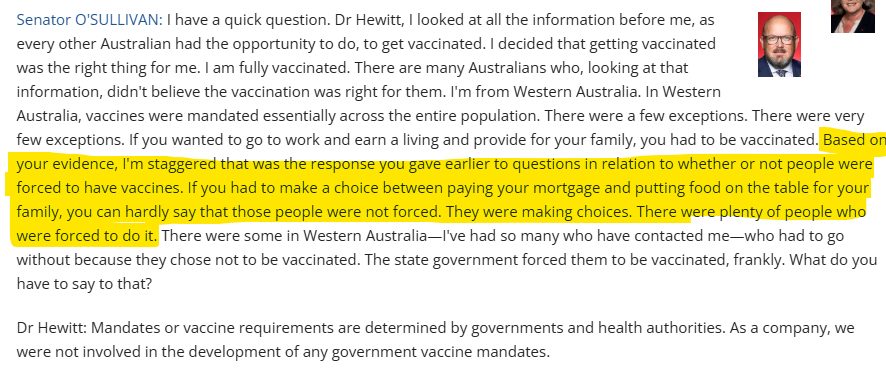
The committee's own Deputy Chair put the underlying question directly to Pfizer at the same 3 August 2023 hearing, in terms independent of any source this piece has otherwise relied on. Senator Matt O'Sullivan, Deputy Chair of the Senate Education and Employment Legislation Committee at the time, responded, after a Pfizer representative maintained no one had been forced to be vaccinated: “If you had to make a choice between paying your mortgage and putting food on the table for your family, you can hardly say that those people were not forced. They were making choices.” That framing, not this piece's own, is a fair statement of the condition Element 2 is trying to describe.

A further condition is harder to document than a mandate date. If a person told a vaccinator they did not want the vaccine and were there only to keep their employment, that statement describes the absence of the voluntariness the Handbook requires. Whether that happened, and how often, cannot be established, because the conditions that would make someone say it are the same conditions that would make them unlikely to say it on the record: disclosure risked the one outcome they could least afford. That incentive structure can be described without claiming to know how many people acted on it.
What can be said is what was not found: no documented case, in any AHPRA record, health complaints commission file, or Senate proceeding searched, of a stated non-consent overridden at the point of care. That absence is read here as an absence, nothing more and nothing less.
Two regulators, tested directly, addressed the individual clinical obligation. In September 2021, AHPRA responded in writing to a formal complaint confirming that practitioners retained an obligation to obtain informed consent for vaccination, meaning a voluntary decision made with genuine understanding of benefits and risks.
Not long before publication of this article, after I wrote to it directly as an independent journalist, the Office of the National Health Practitioner Ombudsman confirmed its position for attribution. Its statement is more revealing than a simple reassurance.
The Ombudsman's office does not, it said, rule on government mandates at all: "our office cannot consider the actions of Commonwealth, State and Territory governments, including in relation to vaccination mandates during the COVID-19 pandemic." And where complaints did fall within its remit, about the regulators' own public vaccination statements, it "generally led to us deciding not to investigate," because it considered those statements consistent with the regulators' role.

The individual practitioner's consent obligation, in other words, was never formally suspended. But nobody was positioned to test whether the conditions surrounding that obligation, the mandate pressure, the compressed clinical encounter, the narrowed field of clinical opinion, were themselves compatible with it.
One oversight body says that question sits outside its jurisdiction; the other's public statements on the matter were the very thing complained about, and those complaints were declined.
What neither body's response addresses is how the obligation was meant to be discharged in practice, within the minutes available at a mass clinic under deadline pressure, and that gap, between an obligation formally intact and a practical environment that gave it little room to operate, is close to the centre of what this piece is trying to name.
It is worth pausing here to stand where an ordinary Australian stood, and to consider not any single one of these conditions but all of them at once.
Pfizer's own chief executive would later describe the vaccine's underlying technology as something that had never before been deployed at scale in a human population, counterintuitive, he said, and accepted on trust in what his scientific team told him.
On the eve of the rollout, the nation's Health Minister told the public the vaccine was safe and effective, in the same breath as acknowledging that the world did not yet know how long its protection would last, and that the global rollout was the largest vaccination trial ever conducted.
That message travelled through channels from which the ordinary constraints on therapeutic claims had been lifted.
The regulator had published its conclusions but not the evidence beneath them.
Practitioners who might have offered a dissenting clinical view carried professional risk for doing so.
Content questioning the official position was referred, at scale, to the platforms that hosted it.
And around all of this, in most sectors and jurisdictions, stood a mandate: be vaccinated, or lose your livelihood, your access to public life, in some cases your ability to cross a state border.
None of these facts, taken alone, establishes that any individual was deprived of consent. But they did not arrive alone. They arrived together, on the same person, in the same moment of decision, and the question this piece has asked from its first page is whether, standing in the middle of all of it, that person was positioned to give the free, informed, uncoerced consent the government's own standard requires.
It is not necessary to allege that these conditions were coordinated to observe that they accumulated, and that their accumulation fell on the individual least equipped to see the whole of it.
Element 3: Was There a Real Choice?
The Handbook's third requirement descends from a standard older than the Handbook itself. The first principle of the Nuremberg Code, adopted in 1947, holds that the voluntary consent of the human subject is absolutely essential, exercised without force, fraud, deceit, duress, or other constraint. It is raised briefly, only because it is the documented origin of the consent lineage the Handbook itself descends from, not a comparison between any government decision and the atrocities that produced it. Those are different scales of harm, and treating them as comparable would be a category error this piece has no interest in making. The Code offers a definition, not an accusation.
Gawthrop was not a vaccination case. It concerned a woman in active labour told she would not be admitted, would not receive pain relief, and would not have her chosen midwife called, unless she submitted to an examination her documented birth plan had declined.
The Court found her eventual agreement was not free and voluntary consent, because she had been left with no real choice between an unwanted procedure and care she urgently needed. Nothing in the judgment considers vaccination or public health policy. What it offers is a general legal principle: that conditioning access to something urgently needed on submission to an unwanted intervention can vitiate the voluntariness the law requires.
Whether that same structural feature was present in the vaccination context is the question this piece has tried to answer using the Handbook's own three-part standard, not the authority of a case that was never about this question.
Taken together, the three elements do not resolve into a single verdict. What they establish is a documented, dated, and repeatedly cross-checked account of the conditions under which a great many Australians made one of the more consequential decisions of their lives: an information environment shaped by regulatory pressure and a referral operation extending beyond its ordinary remit; a formal disclosure of incomplete data that may not have reached most people in the room where the decision was made; mandates that, for the workforce most tightly bound by them, persisted well past the point the government's own regulator judged the evidence complete; two independent transparency tests of vaccine-indemnity terms, both refused; and a stated legal standard for genuine choice that no regulator, when tested directly, has claimed the mandate period suspended.
FOI 26-2668: The Reasoning We Cannot See
Part Two of this series began with a request for the Department of Health's own internal reasoning on the consent standard it applied to Australians during the vaccination rollout. That request remains, as this is written, subject to review by the Office of the Australian Information Commissioner, following a full refusal under section 24 of the Act. If access is eventually granted, the documents will speak more precisely than anything in this piece can. If the refusal is upheld, the refusal itself remains what it has been from the start: a government's own account of its consent obligations, withheld from the citizens that obligation was meant to protect.
Every Person in This Account
This series has been built on a conviction that precedes every argument it makes: that every person it describes is created in the image of God, bearing a dignity and a capacity for reason that no institution and no decision can diminish. That applies without exception to every person named here, including the officials whose decisions this piece has scrutinised most closely.
The Secretary who authorised a communications program under genuine pandemic pressure, the regulator who drafted a statement intended to protect the public from harmful misinformation, the minister who set a deadline believing it would save lives, the AMA president who told viewers an unvaccinated life would be miserable because he believed that to be true, each is a reasoning, image-bearing person who made decisions inside a crisis this piece has had the comfort of examining afterward, with documents they did not have while deciding. Where this piece has fallen short of writing about their structures without presuming to know their hearts, I would want to be told plainly.
The same conviction applies with equal weight to every Australian this piece has tried to describe honestly rather than judge: the person who queued believing wholeheartedly in what they were doing, and the person who queued while quietly certain they were not free. Both are reasoning people, capable of weighing evidence, and both deserved conditions equal to that capacity. Whether they received them is the whole of what this piece has tried to ask.
What an Informed, Equipped, and Consenting Citizenry Requires
This series opened, three parts ago, with a phrase it did not yet have the right to complete: an informed, equipped, and consenting citizenry.
Part One asked whether Australians were informed, and found an information environment shaped as much by what could not safely be said as by what was. Part Two asked whether Australians were equipped, whether the mechanisms meant to let citizens discover their government's own reasoning actually worked, and found an architecture that, tested directly, declined to answer.
Part Three has asked the third question, and the evidence assembled here supports a narrower conclusion than the series' opening phrase might suggest, and I think a more defensible one: Australia did not consistently provide the conditions the government's own consent standard requires. Not that no one consented freely; many did. Not that the standard was never met; in many cases it likely was.
The evidence gathered here is strongest for one group in particular: the healthcare workforce bound longest by mandate conditions, in some states for a year or more after the government's own regulator had judged the underlying data complete.
For many Australians in that position, and others exposed to comparable mandate pressure elsewhere, the conditions capable of satisfying the standard were not reliably present. That gap, between a standard publicly affirmed and conditions inconsistently able to meet it, is the accountability gap this series set out three parts ago to name.
Fallen People, Fallen Systems
There is one more thing this series owes its readers before it closes. It is not an additional finding, but the conviction that has shaped every finding across these three parts. This series has been written from a Christian understanding of the human person. That understanding holds two things together about every person named in these pages: every one of them, minister, regulator, practitioner, citizen, bears the image of God, and every one of them is fallen. The first has been present from the beginning. The second has remained implicit until now.
Fallenness, in this account, does not mean exceptional wickedness. It means the ordinary human inclination, at each decision point, to prefer the protection of the institution, the simplicity of the message, or the meeting of the deadline over the harder disciplines of transparency and restraint. Fallen people build systems, and those systems inherit the same tendency. Fallen systems staff institutions, and the institutions inherit it in turn.
None of this requires a villain to explain what this series has documented: the reasoning withheld, the terms kept confidential, the concerns set aside, the message settled before the evidence was complete. It is what institutions built by people like us tend to do under pressure, unless something outside them holds them to the standard they professed. This is not a new suspicion brought to an old tradition. It is the tradition itself. The same conviction that calls government a necessary burden also requires that the burden be watched, because those who watch are made of the same material as those who govern.
From that same understanding comes the conviction that has driven the central question of this piece, which I state plainly as my own: no human being should control, manipulate, coerce, or take advantage of another for their own benefit or advancement.
That is not a modern political preference. It is the image of God worked through to its conclusion, the recognition that a person is not an instrument to be used, even for good ends, even in an emergency, even by people who sincerely believe they are helping. It is why consent matters. Informed consent is not a bureaucratic formality that circumstances can render optional. It is one of the few places the law still insists that a human being may not simply be used.
Because fallenness is universal, it includes the writer. I have been sceptical of the simplified “safe and effective” messaging for years, before this series began and while it was being written. Readers deserve to know that, not because it alters what the documents show, but because the same tendency that bends institutions toward self-protection can bend a writer toward the evidence he already wanted to find.
That is why this piece was constructed as it was: every claim checked against a primary source, every rejected thread recorded with its reasons, some of what I suspected surviving that process and some of it not. I do not claim to have escaped the tendency. I claim only to have built the checks a fallen writer needs, and to have submitted to them.
The same understanding applies to the officials whose decisions this series has examined. Most of them, in a meaningful sense, stood where every citizen stood, several steps removed from primary evidence, relying on a chain of delegated trust, doing what those around and above them affirmed was right under genuine pressure. Recognising that is not excusing the gap this series has documented. It is the reason the gap must be documented.
If the failure were simply a matter of a few bad actors, removing them would fix it, and three articles would not have been required. The failure is structural. That means it will recur in the next emergency, under different names and with sincerer intentions, unless the mechanisms that hold institutions to their own professed standards, freedom of information that informs, questions that receive answers, regulators whose independence is real rather than claimed, and citizens who keep asking, are stronger then than they were this time.
The Stewardship Close
This series has never asked its readers to trust it. It has asked them to check it. That invitation does not end here. If a reader who supported the vaccination program in good faith, and still does, can point to a document, a date, or a fact that would change the account this piece gives, I want to hear it, and will correct this piece publicly if the correction is warranted. That is not a formality appended to a finished argument. It is the posture this series has tried to hold from its first sentence: that the work of a citizen scrutinising their government is never complete and is worth doing honestly precisely because it might be wrong.
Government is, and has always been in this series' account, a necessary burden, not an enemy to be defeated, but a servant that must continually justify itself to those it serves. Its authority is not its own; it is lent by the citizenry, for the citizenry's benefit, and it is legitimate only so far as it can give an account of itself to the people who entrusted it. That is why the burden must be watched, and kept no heavier than the good it is agreed to do.
This is not a new conviction for this publication but the working-out of a foundation set down earlier, in Christ at the Centre: Christian Political Philosophy and Australia's Forgotten Foundations — that every person carries a dignity no government granted and no government can legitimately remove, and that because those who govern share the same fallen nature as those they govern, their power must be limited, checked, and held to account.
This piece has been that conviction applied to a single question. Stewardship of that inheritance is what this series has tried to practise across three parts, and asks its reader to practise now: to take seriously both the real weight of a public health emergency and the real weight of what a government asks of its citizens when it asks for their consent
Stand at the crossroads and look; ask for the ancient paths, ask where the good way is, and walk in it, and you will find rest for your souls.
— Jeremiah 6:16
Thank you for reading.
God bless,
Mark Neugebauer


Mình coi soi cầu chủ yếu để giải trí, kiểu đọc cho biết rồi tự so với linh cảm của mình thôi. Trúng thì vui một chút, còn sai cũng chẳng buồn mấy vì mình không đặt nặng chuyện thắng thua. Gần đây thấy nhiều người nói về chọn dàn theo chu kỳ, nghe cũng có lý nhưng mình vẫn nhắc bản thân là số liệu cũ không phải lúc nào cũng lặp lại y chang. Mình có lướt vài bài trên soicauxsmb.pro, thấy họ viết khá dễ hiểu, nhất là đoạn giải thích vì sao nên loại bớt vài cặp. Dù vậy mình vẫn thích tự ghi lại và theo dõi xem nhận định nào ổn định hơn theo…