
.png)
When Voting Becomes Compulsion: A Question for South Australia’s Electoral System
As South Australians prepare to vote in the upcoming election, most public discussion focuses on policies, personalities, and the dynamics of campaign debates.
Yet elections are shaped not only by political ideas but also by the institutional rules through which citizens express their choices.
In earlier reflections on South Australia’s election environment, I examined how debate platforms and media visibility can influence which voices voters hear during a campaign.
Another structural feature of the electoral system deserves similar attention:
the way preferences are compelled within Australia’s voting system.
A Longstanding Debate About Compulsory Voting
Australia’s system of compulsory voting is often described as one of the defining features of its democratic culture.
Supporters argue that requiring citizens to attend the ballot box strengthens legitimacy. With turnout regularly exceeding 90 per cent, governments are elected with participation from a broad cross-section of society.
This stands in contrast to many democracies where declining turnout raises concerns about political disengagement.
Yet compulsory voting has long attracted philosophical criticism.
Some political thinkers, particularly those influenced by libertarian traditions, argue that democratic freedom includes the freedom not to participate. From this perspective, voting should remain a voluntary expression of political choice rather than a legal obligation.
Supporters of Australia’s system counter that citizens are not required to vote for any particular candidate. They are simply required to attend the polling place and have their name marked off the roll.
Yet even within this framework, many citizens choose not to participate fully.
In South Australia’s 2022 state election, tens of thousands of enrolled voters did not cast a vote at all, while many more submitted informal ballots. Similar patterns occur in federal elections.
These numbers remind us that even within a compulsory voting system, a portion of the electorate expresses disengagement or dissent through non-participation or informal voting.
For some voters this may reflect practical circumstances. For others, it may represent a reluctance to endorse the candidates presented to them.
In this sense, informal voting can sometimes function as a quiet form of democratic protest, a way for citizens to participate in the process without formally endorsing the available options.
South Australia voting system: Compulsory Voting vs Compelled Preference
In elections for the House of Assembly in South Australia, voters must number every candidate on the ballot paper for their vote to be counted as formal.
Preferential voting allows voters to rank candidates in order of preference rather than selecting only one.
The system was designed to ensure that elected representatives ultimately command majority support.
Yet when preferential voting becomes compulsory, it introduces a different dynamic.
Even if a voter strongly supports only one candidate, they must still allocate preferences to every other candidate on the ballot.
For many voters this is simply a procedural feature of the system.
For others, it raises a deeper philosophical question:
Should democratic participation require voters to formally rank candidates they fundamentally oppose?
Its worth noting that in the South Australian First People's Voice Election there is NO compulsion to vote for more than one candidate
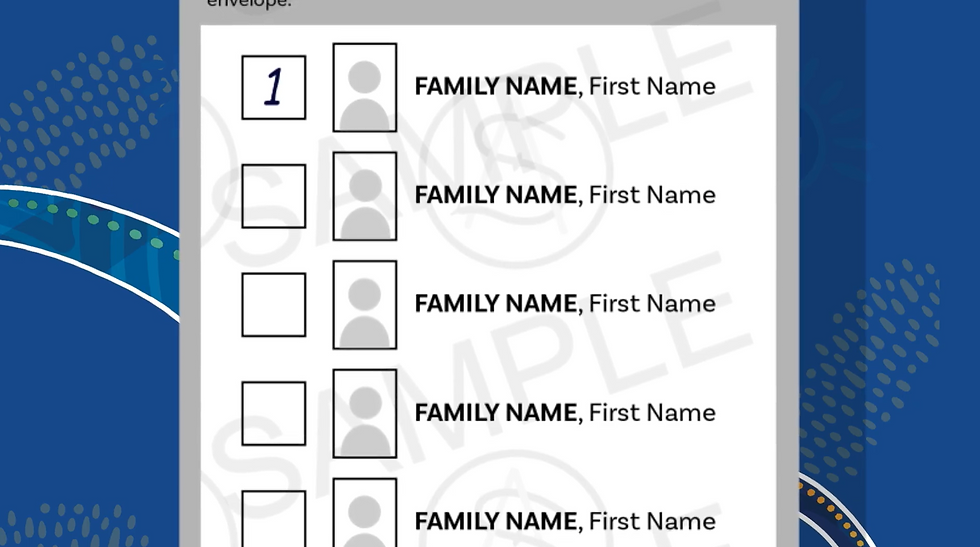
I have covered the South Australian First Nations Voice to Parliament in theses articles:
Compelled Preference in the Legislative Council
South Australia’s upper house illustrates this dynamic in another way.
In elections for the Legislative Council, voters who choose to vote below the line must number at least twelve candidates for their ballot to be counted as valid.
While many voters choose to vote above the line for a party group, those who wish to vote directly for individual candidates must continue allocating preferences until that threshold is reached.
For voters who feel strongly aligned with only a small number of candidates, this requirement can again raise a question of conscience.
Even if genuine support ends after one or two candidates, the rules require voters to continue numbering candidates beyond that point.
Supporters argue that such requirements help ensure orderly counting and clearer electoral outcomes.
Critics suggest that compelling voters to rank numerous candidates risks turning the act of voting into a procedural exercise rather than a clear expression of preference.
Different Approaches Across Australia
Not all Australian jurisdictions approach preferential voting in the same way.
In New South Wales, elections for the Legislative Assembly operate under optional preferential voting.
Under that system, voters may number as many or as few candidates as they wish.
A voter may support only one candidate if they choose, without allocating further preferences beyond that point.
Supporters argue this approach better reflects authentic voter intention.
Critics note that it can produce winners who do not receive an absolute majority of all ballots cast.
The difference illustrates a broader question about democratic design:
Should electoral systems prioritise certainty of majority outcomes, or authenticity of voter preference?
Conscience and the Ballot
For many voters, allocating preferences across a ballot poses no difficulty.
For others, the requirement can feel more complicated.
As someone who approaches politics through a Christian worldview, I often find that my convictions differ significantly from the policy platforms advanced by several parties in contemporary Australian politics, including the Australian Greens and, on some issues, the Australian Labor Party, along with certain aligned candidates and independents.
Such differences are entirely normal in a pluralistic democracy. Citizens bring a wide range of moral frameworks to political life.
But electoral rules still matter.
If a voter strongly supports one candidate yet fundamentally disagrees with others on matters of principle, the requirement to allocate preferences across the entire ballot can feel less like an expression of support and more like a procedural obligation.
This does not invalidate election outcomes.
But it does raise a broader philosophical question about democratic participation:
Should voters be required to rank candidates they cannot in good conscience support?
A System Worth Reflecting On
Australia’s electoral system has served the country well for many decades.
Compulsory voting encourages participation.
Preferential counting often produces stable outcomes.
Yet healthy democracies periodically examine their institutional design.
Questions worth considering include:
• Should voters be required to rank every candidate?
• Should upper-house ballots require preferences across large numbers of candidates?
• Would optional preferential voting better reflect genuine voter intention?
These questions are not about partisan advantage, they're about how democratic consent is expressed.
Before We Vote
Democracy depends not only on the counting of votes, but also on the confidence citizens have in the systems through which those votes are expressed.
Debate platforms, campaign funding structures, constitutional design, and voting rules all form part of that democratic architecture.
Each influences how citizens experience political choice, because elections ultimately belong to the people.
It is therefore reasonable for citizens to reflect periodically on whether the structures through which we vote continue to serve the principles they were designed to protect.
The question is not simply whether citizens vote.
It is whether the South Australian voting system allow that choice to remain genuinely their own.
Appreciate the content? Please consider sharing via the social links below or by copying the link to share via other methods.
You can also subscribe to regular Newsletter's by clicking the Subscribe now button


Comments