
.png)
A Measuring Stick for a Shrinking Freedom: The Australian Christian Freedom Index
Something landed in my inbox recently that I think every Christian in Australia needs to read.
The inaugural Australian Christian Freedom Index, published in May 2026 by the Canberra Declaration, is the first attempt of its scale to actually measure what many of us have been sensing for years. Not just anecdotally. Not just from the occasional case that makes headlines. But systematically, across nine jurisdictions, through an audit of legislation, a catalogue of documented cases, and the survey responses of more than 10,800 respondents from every state and territory.
I want to walk you through it, because the picture it paints is sobering, and because my readers deserve more than a vague sense that “things are getting harder.” This report gives us numbers, names, and a framework. That matters.
What We Already Knew, Now Documented
Let me start with the survey finding that, I suspect, won’t surprise you at all: 92% of the Christians surveyed said it is riskier to publicly affirm Christian beliefs in Australia than it was just five years ago.
Nine out of ten. That is not a fringe opinion. That is the near-universal perception of a community that has been paying attention. And crucially, the report documents that this perception is grounded in legislative reality, concluding that Christian freedoms have been narrowed through 74 Acts passed in Australia’s parliaments over the last 25 years. Almost half of those were enacted in the last five years alone. That is triple the rate of the two decades before.
We are not imagining the acceleration. It is real, and it is documented.
The Silence Gap
Here is the finding that stayed with me longest. When the researchers asked respondents whether they had felt pressured to keep their beliefs to themselves, in public, online, at work, 73% said yes. But when asked whether they had actually been denied an opportunity because of those beliefs, only 25% said yes.
The report calls this “the silence gap.” Most Australian Christians are already self-censoring in anticipation of consequences that, in many cases, have not yet personally arrived. The chilling effect is outrunning the formal discrimination. We have learned, quietly and gradually, to make ourselves smaller.
I think about my own grandchildren growing up into this. What kind of world are we handing them if we don’t push back?
From the Sanctuary to the Public Square
The survey asked respondents how free they felt across different areas of Christian life. The gradient is stark.
Domain | Rated “Somewhat or Very Free” |
Church ministry & worship | 49% |
Sharing faith publicly (evangelism) | 24% |
Christian education | 19% |
Workplace | 13% |
Christian healthcare | 8% |
That last one deserves its own paragraph. Just 8% of respondents rated Christian healthcare as free, meaning over 90% rated it as restricted in some degree. The report documents why: the ACT government’s forced seizure of Calvary Public Hospital in 2023, the first compulsory acquisition of a Christian healthcare provider in Australian history, established a precedent that institutions under government contract can be dispossessed when their convictions become inconvenient.
Voluntary assisted dying laws across most jurisdictions require objecting institutions to arrange patient transfers rather than simply decline, and several states impose referral obligations on individual clinicians as well. Conscience protections that do exist are narrower and more contested than they were a decade ago.
Christian healthcare in this country predates Federation. It now operates in an environment that treats Christian conscience as an obstacle to service delivery.
A Map of What Has Already Happened
One of the report’s most valuable contributions is its case documentation. Using a globally recognised eight-stage persecution scale, it maps dozens of named, documented Australian cases. The report’s assessment is that Stage 3, Discrimination, represents Australia’s current high watermark, though it notes that certain high-profile events, including the Mar Mari Emmanuel stabbing and the Calvary Hospital seizure, have touched Stage 5, Attack. The pattern across the documented cases spans the first five stages: ridicule, harassment, discrimination, defamation, and attack.
I won’t rehearse all of them here, the full report does that far better than I can. But a few stayed with me.
Jason Tey, an award-winning wedding photographer, was taken before a tribunal for seven months, not for refusing a same-sex couple, but for disclosing his Christian convictions in case they wanted someone else. Archbishop Julian Porteous was subjected to a nine-month anti-discrimination process for a pamphlet sent to Catholic school families. Dianne Colbert, a mental health counsellor accredited for over a decade, had her accreditation suspended after complaints about personal social media posts that had nothing to do with her professional practice, and was required to affirm gender fluidity guidelines as a condition of reinstatement.
These are not isolated outliers. Israel Folau lost his rugby contract over a biblical social media post. Andrew Thorburn resigned as CEO of the Essendon Football Club the day after his appointment, when media scrutiny focused on his role as board chair of a church whose sermons, preached by others, nearly a decade earlier, expressed biblically orthodox views on sexuality deemed incompatible with the club’s values.
No finding of wrongdoing in any of these cases. But no one escaped without personal cost.
The cases cluster most heavily at Stage 3, which the report identifies as where pressure on Australian Christians is currently most concentrated and most systematically applied. Indeed, more than a quarter of survey respondents, across a baseline of over 10,800, with domain-specific questions drawing around 10,500 responses, reported being marginalised or denied opportunities in work, volunteering or leadership because of their beliefs.
We are not at Stage 8. But we are not at Stage 0 either.
Victoria and Western Australia: The Poles
The report’s Restriction Index, derived from an audit of 20 specific legislative restrictions across all jurisdictions, reveals a clear hierarchy. Victoria is the most restrictive state by a large margin, with pressures spanning every domain, church ministry, aged care, hiring and enrolment, vilification complaint exposure.
The Equal Opportunity (Religious Exceptions) Amendment Act 2021 has already narrowed hiring exemptions in that state to roles deemed inherently religious under a judicial reasonableness test, and Victoria’s vilification laws, which have been used against Christian pastors for publicly expressing biblical teaching on other religions, are being expanded further still, with the Racial and Religious Tolerance Act 2001 being replaced by a broader Anti-vilification Act from 30 June 2026.
Western Australia is the least restrictive, having successfully resisted many of the impositions that have taken hold elsewhere.
For my readers in South Australia, we sit in the middle of the pack, but with familiar pressures on our horizon. As I documented in Who Targets the Church?, the same international philanthropic network that shaped Australia’s gender identity laws is now systematically targeting the religious exemptions that protect Christian schools, churches and organisations. In SA that means two live legislative threats: the Simms Equal Opportunity (Religious Bodies) Amendment Bill, currently before parliament, which would remove all religious exemptions from the Equal Opportunity Act, and the Conversion Practices Prohibition Act, which is already in force. The pressure here is not hypothetical, and it did not arrive by accident.
Not Special Treatment — Equal Protection
There is a line in the report’s conclusion that I keep returning to: “Christians do not require, and for the most part, do not demand, special treatment. But they do deserve equal protection.”
That is exactly right. And what the report documents is the steady erosion of even that.
The legal framework most Australian Christians rely on is not a set of positive rights but a patchwork of exemptions, defensive carve-outs that can be narrowed, litigated away, or repealed as political winds shift. The Australian Law Reform Commission has already recommended restricting the circumstances in which Christian schools can prefer staff who share their beliefs. The Religious Discrimination Bill 2021 that was meant to address the gap lapsed without passing. The Ruddock Religious Freedom Review of 2018 recommended wider protections; most were never enacted.
The report makes more than forty concrete recommendations spanning constitutional reform, targeted legislative changes, and responsibilities for church leaders, institutions and individual Christians. They are worth reading in full. The boldest call for either a referendum to establish a new constitutional guarantee or a Commonwealth Freedoms Act to protect freedom of speech, religion, conscience and association for all Australians. These are not small asks, but the report is clear that even in the absence of political will for comprehensive reform, meaningful protection can still be achieved incrementally through targeted, discrete reforms.
What the Report Is Asking of Us
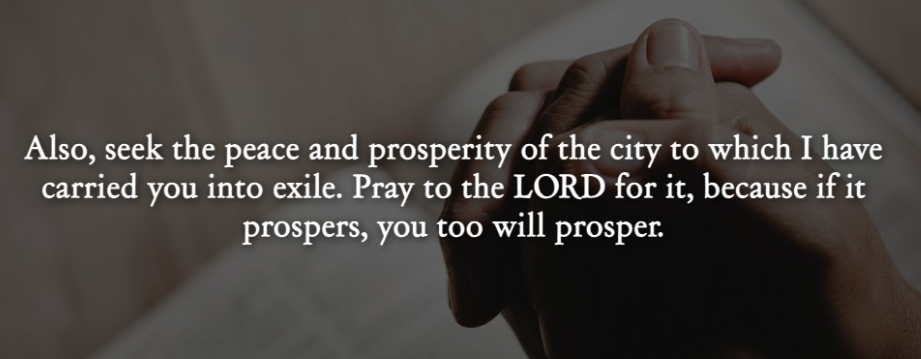
The report closes with a passage from Jeremiah, the prophet’s instruction to a displaced people to seek the peace and prosperity of the city, to build and plant and pray rather than withdraw. That is the call the authors leave us with.
I think it is the right one. Understanding what is actually happening, putting numbers and names to what we have been sensing, is not an act of despair. It is the first step toward a clear-eyed, faithful response.
The Australian Christian Freedom Index is not comfortable reading. But it is necessary reading. It is offered as a summons: to parliaments, to institutions, to church leaders, and to everyday Christians who still believe that the freedoms we have inherited are worth defending, not only for ourselves, but for the grandchildren who will live in whatever country we choose to leave them.
I commend it to you without reservation.
Read the full report at australianchristianfreedomindex.org.au
Until next time,
God bless
Jeremiah 29:7


Comments